

Dale Eisler is a former Assistant Deputy Minister and Consul General in the U.S. He is currently a Senior Policy Fellow at the Johnson Shoyama Graduate School of Public Policy.
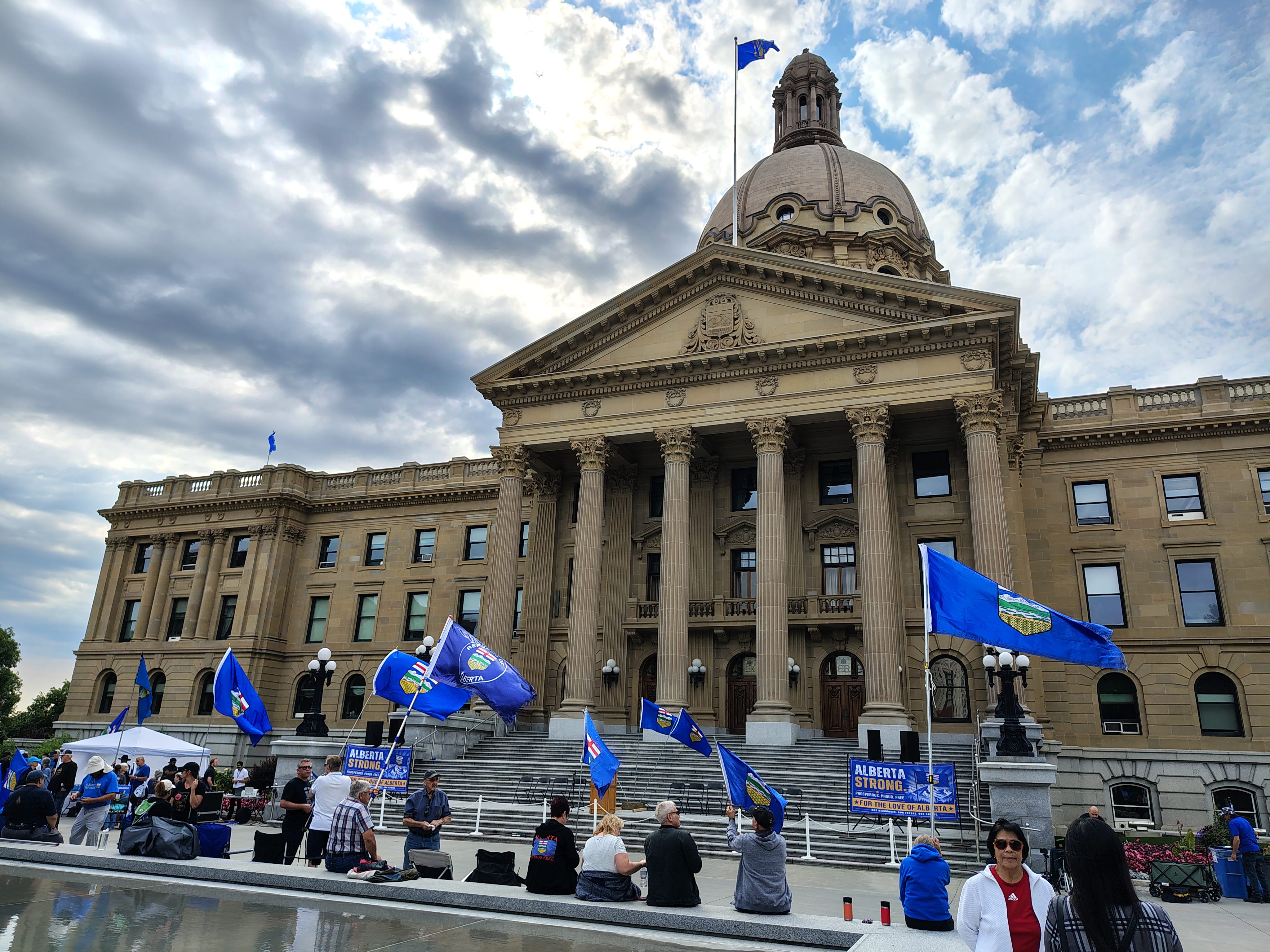
In these days of tariff wars and the looming Alberta referendum on independence, it’s hard to know where to start when considering western “grievance.” I guess a good place would be at the beginning.
That takes us back to the 19th century, the early days of Confederation and the implementation of National Policy. It was purposefully designed to create an east-west national economy that would offset the north-south economic pull of the U.S. There were many dimensions to it.
One was to protect central Canadian manufacturers from U.S. competitors. By imposing tariffs on U.S. imports, the western immigrant farm economy bore the brunt of paying more for Canadian-made products. There was also the construction of a national railway stretching to the West Coast, and immigration policy designed to lure settlers to the prairies.
You might also cite the creation of Alberta and Saskatchewan on the same day in 1905. It was recognized by many as an effort to reduce the political and economic influence of the region within Confederation. At the time the two provinces had the fastest growing immigrant populations in Canada and were seen - apparently feared by some - as a burgeoning economic power. Rather than create one western province, as proposed by Territorial Premier Frederick Haultain, Ottawa decided to have two provinces, thus avoiding one big western province emerging as a counterweight to Ontario and Quebec.
Other shibboleths gave voice to western grievance; the “goddam CPR” had monopoly power over landlocked grain exports, the “big eastern banks” were serving the interests of the central Canada business class, and the “grain elevator oligopoly” was ripping off farmers.
There have been far more recent examples that legitimately fed the notion of western alienation and grievance. The most dramatic was the 1980 National Energy Program. It was seen as a direct assault when the federal government aggressively intervened into provincial ownership of oil and gas. The policy sparked intense opposition in Alberta and Saskatchewan, led to massive disinvestment, recession in the sector, and was reversed five tumultuous years later.
Other “grievances” often cited have been the need for Senate reform and the lack of representation in government decision-making. Of course, in the 10 years leading to 2016 the Prime Minister was Stephen Harper from Calgary, who had a majority government and several high-profile ministers from Calgary, such as Jason Kenney and Jim Prentice. And in the 1980s, Brian Mulroney’s cabinet was filled with senior members from Alberta, including Don Mazenkowski, Harvie André, and Joe Clark.
But history is hardly the whole story when it comes to judging grievance. When you consider the Alberta referendum’s litany of 10 questions - and the voice each gives to the protest mentality - in the context of other facts, the complaints fall flat.
That’s not to say that Alberta doesn’t have some legitimate criticisms. All provinces do. One near the top of the list for Alberta is equalization, which is based on each province’s fiscal capacity. Alberta, and some other provinces, argue that Quebec unfairly benefits because its potential tax revenue from hydro resources is kept artificially low, allowing it to undeservedly receive equalization payments. It’s a genuine issue and arguably a design flaw in the equalization formula.
Some Albertans complain loudly about “paying into equalization.” They see it as a direct transfer of wealth to Quebec. The truth is no province “pays into” equalization. It is a federal program. Albertans, like all other Canadians, pay federal tax and Ottawa funds equalization from its overall revenue sources.
Accepting those “grievances”, the question becomes what has been the economic and social result that has led some aggrieved Albertans to want to break free of Canada? One would assume the evidence must be stark. Admittedly, there are other less strident people who stop short of threatening separation. They want policy changes that address what they see as Alberta priorities. For them separation might come later if their demands are not met.
In that context, what are the facts that put Alberta’s supposed raw deal in such sharp relief? One would assume the economic grievances would become apparent in comparative economic data with other provinces that don’t feel the same alienation.
So, what does the evidence tell us?
First off, Alberta is the wealthiest and most prosperous province in Canada. According to Statistics Canada, its 2024 median income ranked first among all provinces at $85,300. Second was Ontario at $79,500. The Canadian average was $75,500. Alberta also leads all provinces in average salaries, which in 2023 was $139,849. A distant second was Newfoundland and Labrador at $119,658.
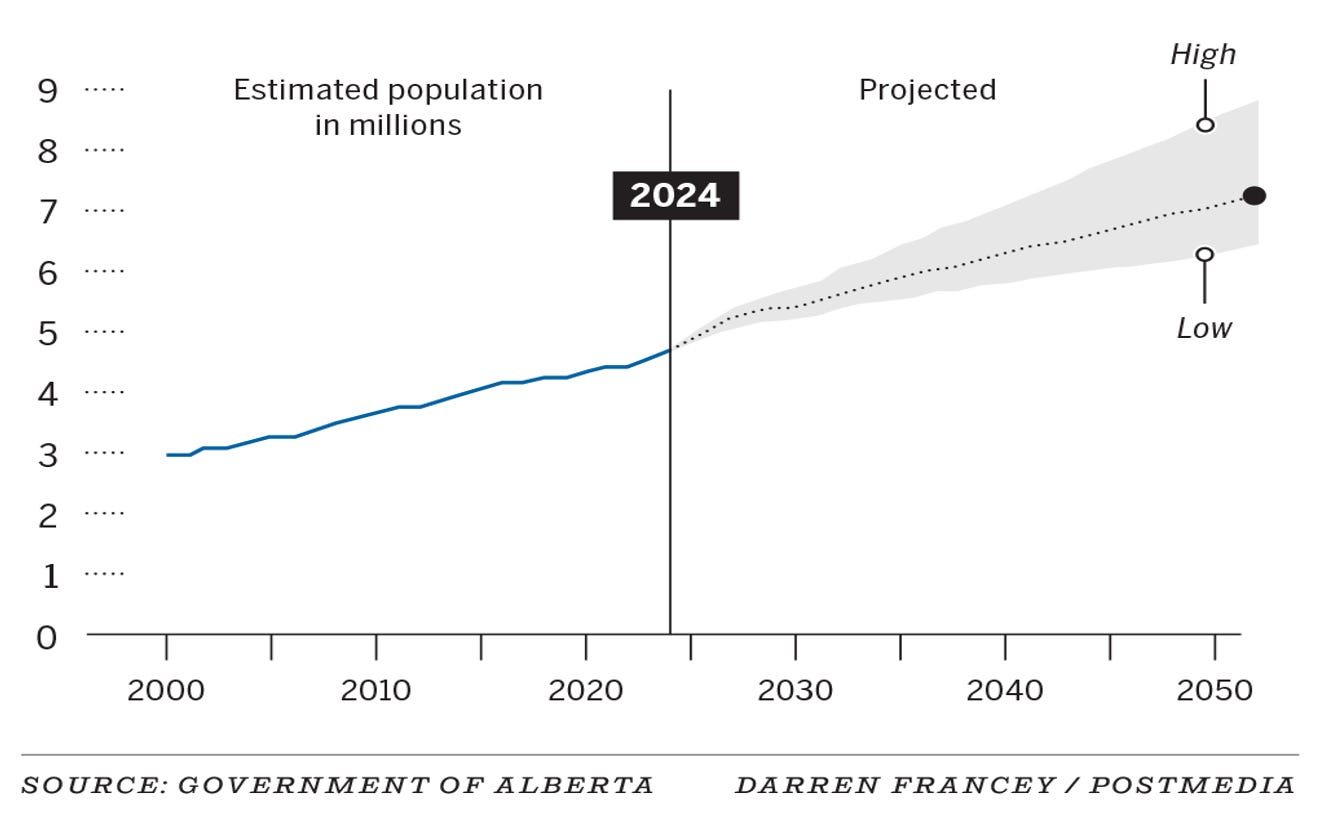
Then there is what the Alberta government often likes to refer to as the “Alberta Advantage.” It’s based on what differentiates Alberta from other provinces. It specifically points to low taxes, including no provincial sales tax, low regulation, and a growing economy and population. The advantage has proven true. Alberta has led all provinces for decades in rate of population growth, and as the graph below indicates the population is expected to continue climbing.
Alberta’s Growing Population
What about oil production, which always seems to be the crux of the matter? Surely that explains the anger. A core “grievance” has been that growth in Alberta’s oil and gas sector has been purposefully stunted, especially for the past decade by federal policies specifically related to the environment and climate change.
Here’s a graph from the Canada Energy Regulator that shows total oil production in Canada by year, from 2000-2025. Other than a decline in 2020, in part the result of the economic consequences of COVID pandemic, oil production has grown steadily. It’s worth noting the growth from 2016-2025 which is often cited as the period when the federal government was hell bent on phasing out the oil sands.
Rising Canadian Crude Oil Production
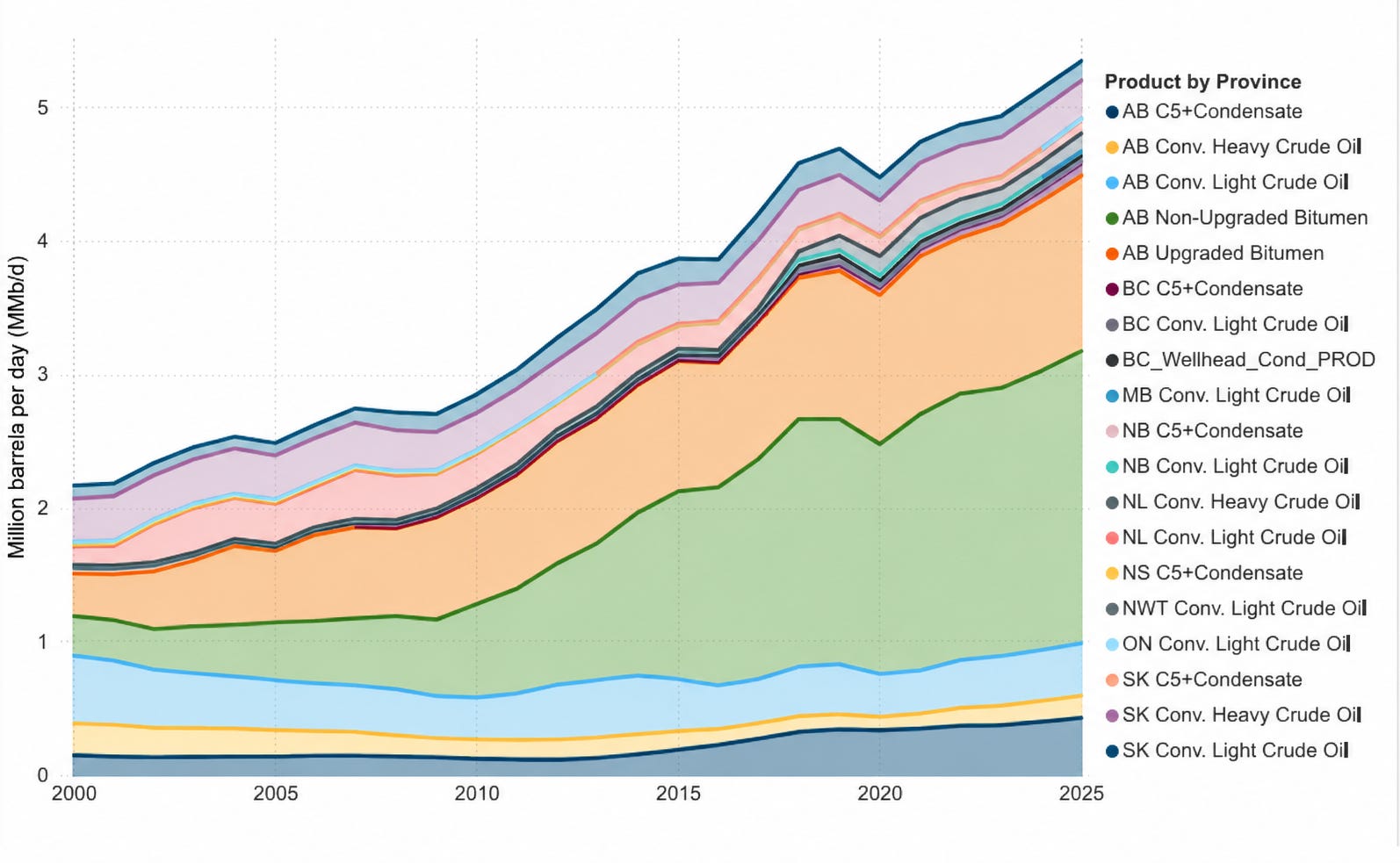
What the graph shows are the various types of crude oil and the year-after-year new records that have been set for Canadian oil production. It was the same story in 2025, when Canadian production averaged 5.35 million barrels per day (MMb/d) of crude oil and equivalents, up from 2024’s record of 5.14 MMb/d. Production grew throughout the year to a high of 5.64 MMb/d in December 2025.
In 2026, approximately 84 per cent of Canada’s oil production comes from Alberta, the vast majority out of the oil sands. As noted by Don Wright, former Deputy Minister to the Premier of B.C. in a recent Sage Substack article, a key federal policy to support the oil sands came into being in the 1996 budget when the Liberal government of the day provided accelerated capital cost allowances to oil sands developers. Coupled with changes to provincial royalties, it led to 20 years of massive investment flows into the oil sands totaling $360 billion.
In 2018 the former Justin Trudeau government announced it would rescue the abandoned TMX pipeline project to the West Coast, in what was a direct support to oil sands expansion. The total cost was $34 billion. Today, TMX carries almost a million barrels a day of bitumen from the oil sands to export position in Vancouver. A second proposed pipeline from Alberta to the West Coast is being planned, largely financed by the federal and Alberta governments.
As for the sector itself, oil producers are reporting big earnings. One example is Suncor., In its 2026 second quarter, Suncor reported net earnings of more than $3.7 billion, up from slightly more than $1.1 billion for the same quarter a year ago. A year earlier it produced $5.8 billion of shareholder returns, made up of $2.8 billion in dividends and $3.0 billion in share repurchases. According to IBIS World, a global industry intelligence company, oil and gas extraction is Canada’s fastest growing industry with revenue growth of more than 25 per cent for the year.
Yet, in spite of the facts, and with Canada in the midst of a trade war triggered by U.S aggression to weaken Canada’s economy and independence, there remains a minority of aggrieved Albertans who want their province to leave Canada. This, at a time when the vast majority of Canadians are standing up for their country in response to Donald Trump’s threats. There’s a word that comes to mind that describes people disloyal to their country.
One could go on, but what’s the point? Canada is ranked as having the most decentralized federal government among the world’s major nations. Unlike states in the U.S., Canadian provinces have exclusive jurisdiction in key areas such as development of natural resources. In any federal system there will be examples of disagreement. But overall, it has served the provinces, and the nation, well. And the best example is Alberta.
If you enjoyed this, you may also like from Sage:




To the Dale Eisler’s list of support to Alberta provided by the Feds, I would add the $600 million bailout of Syncrude in the mid 1970’s; the early 1960’s edict by conservative Prime minister John Diefenbaker that decreed Canadians should consume only Western Canada oil; the mid 1950’s furious political debate to push through construction of the TransCanada Pipeline that led to Diefenbaker-led Conservatives winning the federal election; the mineral (including oil and gas) rights granted to the Canadian Pacific Railway company, which morphed into the very profitable CP Oil and Gas; the water irrigation system that criss crossed Southern Alberta in support of development of Alberta agriculture. Where I do have some sympathy for the Western provinces is the very irritating election practice of releasing vote tallies before the West has completed voting.
Thank you Sir!
More such clear commentary from multiple sources "might" help explain to the confused and aggrieved that this is a movement of volume, not substance.
What will it take to quiet this angry cabal of village idiots when they lose?