

Don Wright has served at the Deputy Minister level in the Saskatchewan and British Columbia governments. He currently serves as a Fellow with the Public Policy Forum, a Senior Fellow with the C.D. Howe Institute, and Senior Counsel with Global Public Affairs.

We are currently seeing lots of worrying about the job-killing potential of AI. In the U.S., for example, there is this recent piece from Bernie Sanders. And Avi Lewis’ platform, in his successful run for the NDP leadership, had this to say:
“Corporate AI’s success is predicated on causing mass unemployment in Canada and around the world – to keep the bubble from bursting, AI products need to deliver higher “productivity,” otherwise known as rapidly displacing millions of paid jobs.
[emphasis in the original text]
This anxiety isn’t coming only from the left. Prominent Conservative commentator Sean Speer recently asked “Can We Survive the Journey to AI Abundance?”
This is nothing new. Ever since the start of the industrial revolution, more than 250 years ago, angst about new technologies — that they will eliminate jobs, increase unemployment, and reduce workers’ living standards — has been a recurring theme. The most famous historical example was the Luddite movement in England between 1811-16, but there is no shortage of other examples. For an instructive scan of some of these, check out “Robots Have Been About to Take All the Jobs for 100 Years”.1
There are significant issues with respect to AI we must carefully think through, and for which we must develop appropriate policy responses. Some of these were discussed in a recent Sage podcast:

But an overblown fear of job losses should not sit at the top of the leader-board of issues about which we should be worrying. A modern-day version of Luddism risks frustrating the utilization of what may prove a significant and long-needed tool to address Canada’s abysmal productivity performance.
Improvement in Our Standard of Living Requires the Elimination of Jobs
The boldface heading above might seem callous, but let’s explore why it is true, by looking at a period when Canada’s growth in productivity was particularly robust: 1950-75.
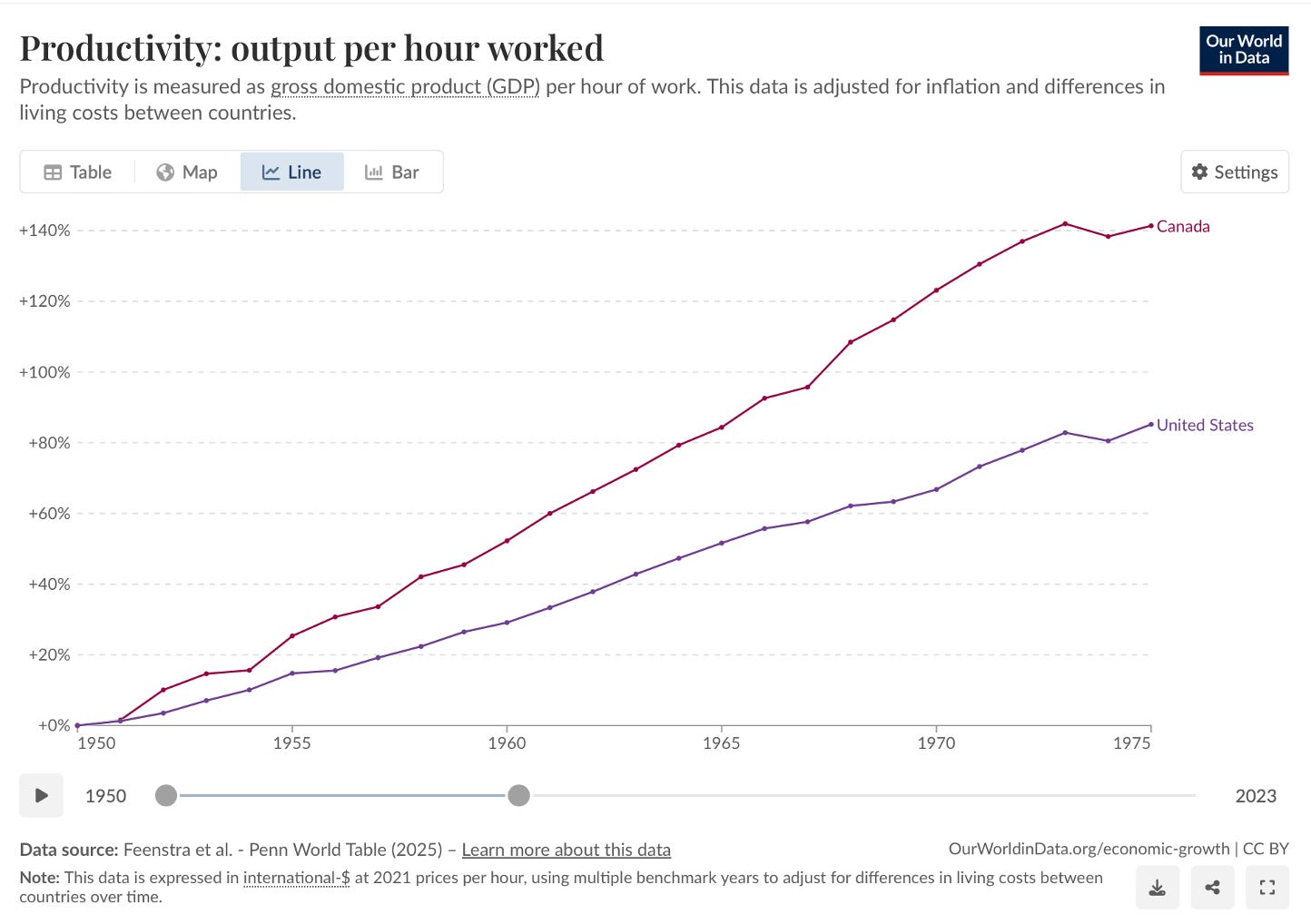
Figure 1 below shows the growth of labour productivity for Canada and the U.S. over this period. In 1975 the average Canadian worker produced output worth — after correcting for inflation — 2.4 times as much as what their counterpart produced in 1950.
Figure 1 – Canadian and U.S. Growth in Output per Hour Worked, 1950-1975
At first blush it might seem that such dramatic improvements in productivity would have meant fewer jobs: if each worker could produce more in the same period of time, then we would need fewer workers. But this reflects what has been called the “lump of labour” fallacy – the notion that there is a fixed, finite amount of work to be done in any economy.
A moment’s reflection reveals why this is indeed a fallacy. Society’s needs and wants are not finite. We like new stuff. We like better quality stuff. We like to go out to eat. We like to go to concerts and sporting events. We want better-quality health care and other public services. Perhaps we would also like to “consume” more leisure — in 1900 the average work week for full-time workers in Canada was 62.6 hours; by 1950 that had fallen to 42.3 hours; by 1975 it was down to 39.1 hours. There will never be a shortage of needs or wants on which increases in productivity can be “spent.”
There is, however, a challenge arising from what might be called “varying proportions.” If productivity grew at the same rate in all industries in the economy, and if demand for all goods and services grew at the same rate, then no worker need be displaced — our economy would just increase output across the board, and we would all consume more of everything, at the same rate of increase.
But that is not how things unfold. Some industries will experience quite rapid rates of productivity growth, others less so. As people get richer, they will choose to spend relatively more of their income on some types of goods and services, relatively less on others — this also holds for the goods and services we choose to consume collectively through our governments. In order to maximize the benefits arising from higher productivity, it will be necessary to reallocate resources — workers and capital — from some sectors to others. Stated bluntly: some jobs will need to be eliminated.
This doesn’t mean that total employment will go down. Rather, many people whose jobs are eliminated will find employment in other sectors that are expanding. Over the 1950-1975 period, even though the 1975 worker was 2.4 times more productive than the 1950 worker, the percentage of the adult population that was employed rose, and there were almost twice as many workers employed in 1975 as there were in 1950. In the aggregate, improvements in productivity did not lead to a reduction of jobs.
Furthermore, the improvements in productivity led to a dramatic improvement in Canadians’ standard of living. In particular, the average Canadian real wage rose significantly — the purchasing power of the average hourly wage in 1975 was 2.5 times greater than it was in 1950.
Canada’s Productivity Performance Has Gotten Progressively Worse Since 1975
Figure 1 showed that Canada’s productivity-growth performance was significantly better than that of the U.S. over the 1950-75 period. Figure 2 below shows that Canada’s record in productivity growth has become progressively worse since 1975 — not just in absolute terms, but relative to the U.S.
Figure 2 – Average Growth Rates in Labour Productivity, Canada and the U.S, 1950-2024 (Compound Average Growth %)
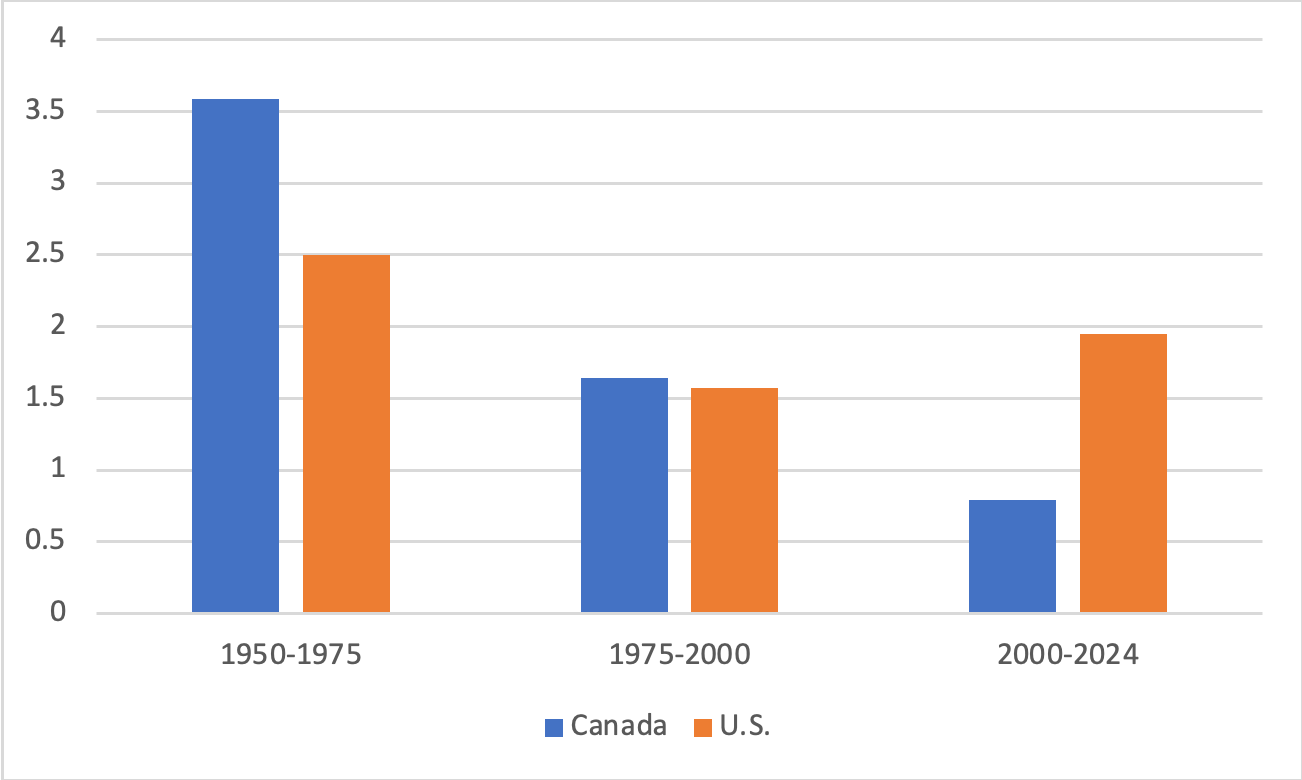
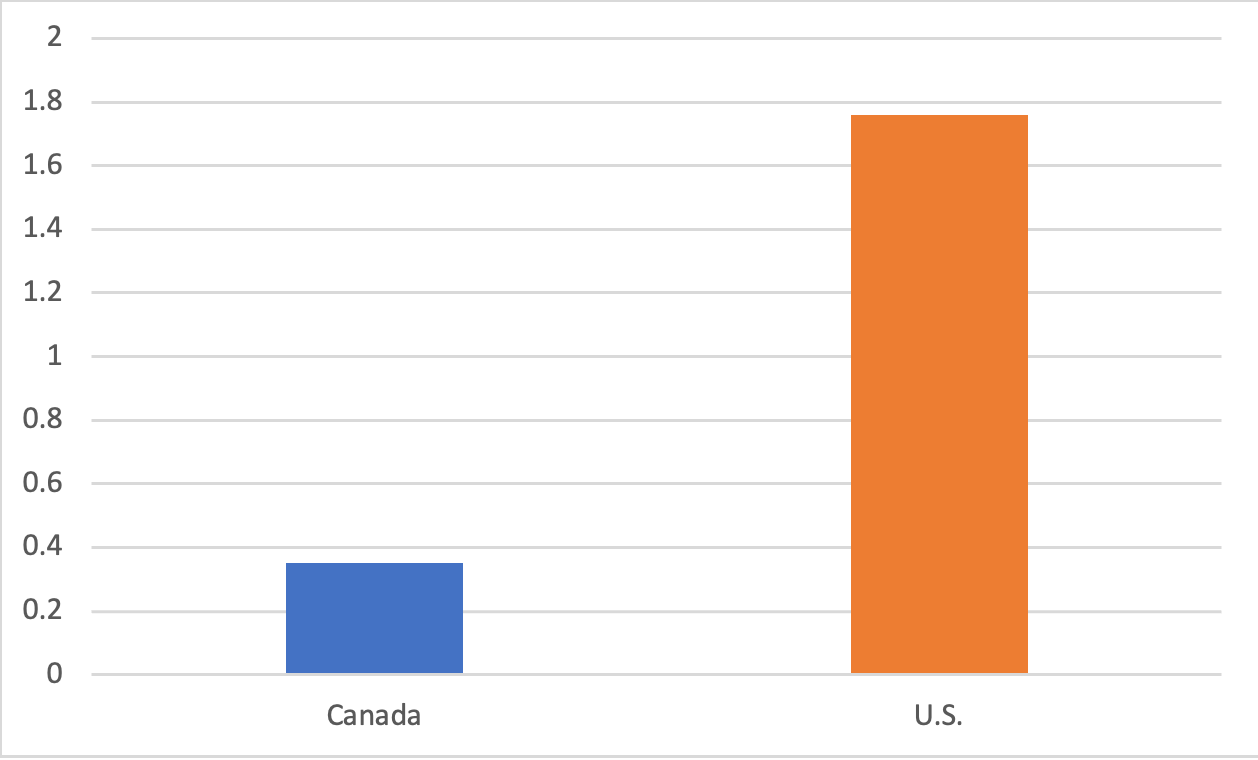
Both countries saw a decline in their productivity growth rate after the postwar period, but the U.S. managed to stabilize and slightly improve its performance over the past quarter century, while Canada’s performance continued to deteriorate. Our relative under-performance since 2014 has been particularly stark, as shown below in Figure 3. The U.S. managed the disruption of the COVID lockdowns without markedly slowing down the rate of productivity growth; Canada not so much. The trend is definitely not our friend.
Figure 3 - Average Growth Rates in Labour Productivity, Canada and the U.S, 2014-24 (Compound Average Growth %)
This poor productivity performance translated into extremely disappointing real wage gains for Canadian workers. Between 1975 and 2024 the average real wage rose by a mere 19%, compared to 147% between 1950-75. To put that into perspective, the rate of growth in 1950-75 resulted in a doubling of real hourly wages every 19 years, while it would require 196 years to double real hourly wages at the rate of growth since 1975.
I have argued elsewhere2 that a primary cause of this disappointing productivity and real-wage performance has been the “cheap labour” strategy practiced by Canada’s federal government (aided and abetted by the business community and provincial governments) over the past five decades. The essence of my argument is that labour markets must be kept sufficiently “tight” or “warm” to impel businesses to:
1) be constantly making investments in improving productivity,
and
2) share fairly the benefit of those productivity gains with their workers by way of higher real wages.
The two go together; it is the prospect of needing to pay higher real wages over time that motivates business to invest in improving productivity, and those increases in productivity are necessary to afford those higher real wages.
If government policy is overly fixated on keeping inflation (and wages) low, it is more prone to allow labour markets to remain “loose” or “cool,” undermining workers’ bargaining power with employers. Similarly, if government policy is too craven to businesses’ constant complaint about a “worker shortage,” it responds by allowing higher levels of temporary workers, also undermining the bargaining power of workers. Weaker bargaining power for workers equals less need for employers to raise wages, which further equals less imperative to invest in improving productivity.
What Has this Got to do with AI?
AI may turn out to be a general purpose technology, analogous to electricity, that will significantly improve productivity across most economic sectors — both private and public. I emphasize “may” because I believe we are currently at the “Peak of Inflated Expectations” in the Gartner “Hype Cycle,” making it difficult to discern just how significant and how widespread the impact of AI will be.
But let’s suppose that the potential for broad productivity growth through widespread application of AI tools is real. What is the appropriate policy stance of government? Should we, as Bernie Sanders and Avi Lewis seem to suggest, strangle the baby in its cradle?
I sincerely hope not. We have, as the deputy governor of the Bank of Canada said in 2024, a ”break-the-glass” productivity crisis in this country. It also happens to be at the root of our affordability crisis, the growing pessimism about the prospects of younger Canadians and an inability of governments to deliver the level and quality of services that Canadians expect at the level of taxes they are willing to pay. Why would we turn our back on a tool that may become a significant factor in turning all that around?
There will be many dimensions of the policy framework needed to maximize the benefits and minimize the harms of widespread adoption of AI across Canada’s private and public sectors. Here I will focus on just one, which I believe to be critical.
The relatively happy picture depicted above for the 1945-75 period lies in contrast to what happened during the early stages of the industrial revolution. The best data for that period comes from Britain. Real wages there fell by 48% between 1750 and 1801, and didn’t fully recover to their 1750 level until 1848, despite the fact that over that period British GDP per capita rose by 61%. It was only in the second half of the nineteenth century that workers began to share the benefits of higher productivity. The Luddites actions should be understood as reactions to changes that were significantly reducing workers’ standard of living.
What was the difference between the early stages of the industrial revolution in Britain and the 1945-75 period in Canada? The relative bargaining power of workers was much stronger in Canada in 1945-75. Partly that was a function of very different labour laws. In addition to that, I want to emphasize here, is that the Canadian government was committed to using the tools of fiscal and monetary policy to maintain full employment. This was set out in a remarkable policy document – CD Howe’s White Paper of 1945, which explicitly connected full employment and innovation.
This commitment to full employment provided the political licence for increases in productivity and the corresponding need to reallocate resources from one sector to another – i.e., the elimination of some jobs, to be replaced by new jobs elsewhere. Displaced workers have more assurance that alternative employment will be available when they are in the “tight/warm” labour market that full employment entails, and therefore workers have more openness to change.
The widespread adoption of AI will lead to faster productivity growth, in turn raising the effective “speed limit” at which the Canadian economy can be run without an acceleration of inflation. It is critical that the Bank of Canada and the Minister of Finance explicitly recognize and accommodate this connection by following monetary and fiscal policy that is more stimulative than it otherwise would have been.
If they do not provide this more stimulative macroeconomic environment, then the fears of the “Neo-Luddites” will be realized – AI will eliminate jobs, and too few new, alternative jobs will be created. Furthermore, employers will not be compelled to share productivity gains with their employees because the slack in the labour market will have undermined worker bargaining power. All things considered, this would not constitute a happy result, and it should be expected that public support for widespread adoption of AI would quickly evaporate.
AI may, as I said, turn out to be a general purpose technology that can deliver significant, widespread improvements in productivity and, if that is the case, it can make a meaningful contribution to counteracting the economic, political and social malaise that has afflicted Canada for far too long. That will be a good thing, even if it means some jobs will be eliminated. But that happy result relies on us getting the policy framework right. Bank Governor Macklem and Finance Minister Champagne, please be prepared to go a little lighter on the brake and a little heavier on the gas.
If you liked this piece, you might enjoy these:

For other examples of technophobia going back to Roman times check out “Will Technological Progress Impoverish the Poor and Working Classes?”
Hits different when it's your job that disappears and those who do it cackle on your way out
Wishing job losses on the masses feels misguided.
I will be interested to read the words of C.D. Howe with genuine interest. Thank you for sharing that link. Canada knows the think tank that carries his name well; we are perhaps less familiar with the work and thinking of the man himself. I appreciate you raising the alarm about Canada's dismal labour productivity record. That signal deserves to be amplified, not diminished. On this point, I suspect we agree completely: Canada has a productivity problem, and it has persisted far four decades too long.
Every major political party has taken its turn promising to fix it. Liberals, Conservatives, New Democrats—each has identified the problem, offered prescriptions, and ultimately failed to reverse the trend. It is quite a record, actually. It is as if we expect as little result from government policy as we do from the Maple Leafs. Still, your reader deserves more explanatory depth than they get here. There is no case to be made for wishing unemployment on the masses, for its own sake. The important question is where the LMP problem actually lives. And this is where I think your argument becomes less convincing. I agree with parts of your diagnosis. I am less persuaded by the explanation.
Labeling Bernie Sanders a “baby strangler” is certainly memorable. And the follow-up—“Was I being too callous? [Boo hoo.]" is an impressive demonstration of certainty. Perhaps, though, the essay would benefit from supporting that certainty with a little more logic. Much of the argument moves quickly from observations to conclusions without sufficiently examining the assumptions that connect them.
Consider the claim that [all] job loss is ultimately good for an economy. It is a powerful statement, but powerful statements require powerful evidence. Does this mean that every instance of displacement automatically produces prosperity? Does it include workers whose skills become obsolete faster than new opportunities appear? Does it include communities that lose their economic foundation? Does it include workers who never participate in the productivity gains created by their displacement; if they move from the auto sector to counter work at Tim Horton’s for instance? If so, what would C.D. Howe say about a K-shaped economy where growth occurs, but its benefits accrete unevenly?
The same challenge applies to the argument that Canada's political class simply needs to allow the economy to run hotter. Perhaps. But hotter toward what end? An economy can expand while still failing to create globally valuable products, intellectual property, and companies that define markets. The United States is not simply more productive because its government is more enthusiastic about technology. It is more productive because it has created an extraordinary concentration of companies that develop new categories, commercialize innovation, attract talent, and create value for global consumers. Not just USA.
This distinction matters because productivity is not created by technology adoption alone. It is created when organizations use technology to fundamentally improve how they create value. The personal computer did not transform productivity simply because computers existed. The Internet did not transform productivity simply because everyone gained access to browsers. The companies that benefited most were those that redesigned themselves around new possibilities. Technology was involved; organizational imagination was the multiplier.
The argument that workers displaced from declining sectors will naturally migrate into rising sectors also deserves more careful examination. Historically, this transition has been neither automatic nor painless. The Industrial Revolution offers a useful reminder. The Luddites were not cartoonish people who hated machines. That caricature is convenient, but historically false. They were skilled workers objecting to the conditions under which technology was introduced: wage suppression, loss of bargaining power, destruction of skilled entrepreneurship, and the absence of institutions capable of ensuring that productivity gains translated into broadly shared prosperity.
The uncomfortable fact is that Britain experienced extraordinary productivity growth while many workers experienced nine decades of insecurity before those gains became broadly distributed. The argument that disruption eventually created prosperity may be true, but “eventually” is doing an enormous amount of work. Try explaining that promise to your children: “Good news kids! The economy will eventually become stronger. Unfortunately, your working life will be defined by instability, declining bargaining power, and diminished prosperity. But please understand—the productivity statistics will look better, er... eventually.” Thanks, kids. Canada is going to love you.
As rhetoric goes, dismissing Luddites is nothing new. I first learned that trope forty years ago in college—the supposedly left-wing academy that still served the same tired narrative hash with eggs over easy: technology arrives, humans adapt, progress wins. Except history is rarely that clean. The important lesson from Luddism is not that technology should be resisted. It is that societies must ask who benefits from technological change, who bears its costs, and what institutions are required to ensure that prosperity is broadly shared.
The same problem shows up in the discussion of artificial intelligence. The essay repeatedly moves from using “AI may” to “AI will.” That is a small linguistic shift carrying a very large intellectual burden. AI may become one of the most important general-purpose technologies in history. It may transform productivity. It may reshape knowledge work. But those are hypotheses worthy of examination, not conclusions that exempt themselves from criticism.
Your own Canada-versus-US productivity chart (fig. 2) appears to tell a more complicated story. Canada did not reject the personal computer revolution. Canada did not reject the World Wide Web. Canada did not reject the mobile computing revolution. We participated in all three with an emphatic me-too. Yet Canadian productivity continued to decline relative to the United States as Fig. 2 makes clear. If the lesson from history is simply that Canada needs to embrace more technology, then the evidence of the past five decades should give us pause.
Perhaps the missing variable is not adoption. Perhaps the missing variable is ambition.
As we know from lived experience Canada's challenge is not that we fail to adopt technology. Maybe our challenge is that we too often acquire technology without developing the innovation discipline required to transform it into value for people. We tag along. We drift behind the rider in the lead. We optimize tired business models. We improve efficiency. We reduce costs. But too rarely do we create globally significant products, services, and companies that redefine markets. And when we do (Nortel, RIM, etc) we grow conservative as soon as we can.
This raises a more uncomfortable question: perhaps the lever of change is not primarily located in the Prime Minister's Office. Perhaps it is located in the boardrooms of Canadian companies? Governments can create conditions for Corporate prosperity. They can fund research, improve infrastructure, negotiate trade agreements, and establish rules. But governments cannot understand customers better than companies do. They cannot design better products. They cannot build globally admired brands. They cannot create the courage required to leave comfortable markets and pursue uncertain opportunities.
So perhaps the question we should be asking is not whether Canada will adopt AI. That answer is already clear. Governments, investors, and companies are treating AI as inevitable. The more important question is whether Canada will use AI to create new value—or simply use AI to make our existing systems cleave off a massive chunk of the Labour Market (for nine decades to come).
Because productivity is ultimately not a technology problem. It is a human ambition problem. It is a creativity problem. It is an innovation discipline problem. It is the ability to imagine something different for a market, build it, ship it with real people, and bring it successfully into the world. It is the ability to compel customers from 80 or more countries around the world, rather than one tempest next door.
One final thought experiment: when was the last time a Canadian CEO publicly launched a truly market-defining product? Not an acquisition. Not a restructuring. Not a white labeling. Not a cost-reduction initiative. A product or service that changed expectations and created a new category.
Can we name ten? Can we name fifty?
Until we can, Canada's prosperity will remain vulnerable to the same entropy that has defined the past half-century. The challenge is not that Canadian consumers are insufficiently willing to adopt the future. The challenge is whether Canada's Exectuives are sufficiently confident that we have the creativity to ship ideas that a whole world demands.