
When Efficiency Eclipses Equality
John Hancock
John Hancock works at the World Trade Organization in Geneva, Switzerland where he has served as senior advisor to the Director-General, head of policy development, and representative to the IMF, World Bank, G20 and G7. The views expressed in this article are his own. They are not intended to reflect views of WTO Members or the Secretariat.
The great promise of the post-war era was that growth and fairness could advance together. That promise is breaking down – not just because of government failures, but because the nature of growth has changed. The same knowledge economy that is generating extraordinary growth requires fewer people to create it – and concentrates its rewards in fewer hands. Today’s increasingly divided and unstable societies are features, not bugs, of modern economies.
Economists have long recognized that efficiency and equality involve trade-offs. Policies that prioritize innovation, competition, and creative destruction often produce unequal and disruptive outcomes, while policies that prioritize redistribution, regulation, and social protection can weaken incentives to invest, compete, and innovate.
This trade-off was easier to balance in an industrial economy. Growth required factories, machines and, above all, millions of workers. As firms expanded and productivity increased, they employed more people, competed for labour, and shared at least some proportion of productivity gains through rising wages. The tangible nature of industrial production also made redistribution easier. Physical capital was rooted in particular places, firms and workers were easier to tax and regulate, trade unions could bargain collectively, and stable wage employment provided a broad fiscal base. Industrial economies distributed a share of rising wealth through the labour market and then governments redistributed even more through public policy.
Today’s knowledge economy makes that balance harder to sustain – because where industrial economies depended on the mass employment of labour, knowledge economies depend on the mass deployment of ideas. Ideas are different from physical capital in at least two contradictory respects. On the one hand, ideas, unlike goods or resources, can be replicated and distributed without limit at almost no additional cost. On the other hand, the ideas that matter most are rare - created by relatively few exceptionally talented and knowledgeable people, and often developed at enormous economic cost. That combination of scarce creation and limitless replication is what makes the knowledge economy so powerful - and so unequal.
Their characteristics also create powerful increasing returns – as successful ideas draw in more users, generate more data, attract more investment, and fuel more innovation – further reinforcing competitive advantage. Software can be written once and copied a billion times without the need for more workers, factories, or containers. Digital platforms become more valuable as more users join them, creating winner-takes-most markets. Artificial intelligence improves as it absorbs ever larger quantities of data, reinforcing the advantages of early innovators.
If the economics of the knowledge economy create a structural tendency towards greater concentration, competition reinforces it still further. The more valuable knowledge becomes, the more intensely firms and nations race to create it, commercialize it, and dominate the industries it creates. Firms compete relentlessly to develop better algorithms, recruit the best minds, capture ever larger datasets, and deploy increasingly efficient and intelligent machines to replace expensive human capital. Governments compete just as fiercely to increase innovation, fund research, host cutting-edge firms, attract the needed investment, and lead the technological race against geopolitical rivals. It is not that governments favour inequality; rather, the competitive logic of the knowledge economy reinforces the structural tendency to put efficiency before fairness. For governments, the choice appears stark: innovate or fall behind.
This intense global competition to innovate generates still greater economic progress. But it also magnifies the forces that concentrate its rewards. Stock markets surge and house prices rise even as layoffs increase and living standards erode. More wealth is created, but it increasingly accrues to those who own the capital – algorithms, data, intellectual property assets – rather than those who supply the labour. Productivity growth continues to rise even as fewer workers are needed to generate it and labour’s share of national income declines. At its peak, Ford employed a quarter of a million workers – because in the industrial economy, workers were the source of value. Nvidia has just 42,000 employees and is 84 times more valuable – because in the knowledge economy, ideas are.
Political consequences inevitably follow. When large sections of society feel that growth is only benefiting a relatively narrow elite – and fear they are falling further behind – trust in government, democracy, and free markets begins to erode. Grievance and resentment increasingly shape politics on both Right and Left. Economic insecurity increasingly expresses itself through cultural conflict, as debates over immigration, identity, and national sovereignty become proxies for deeper anxieties about opportunity, status, and fairness.
The contrasting experiences of the United States and Europe illustrate this dilemma. The United States has become the world’s unrivalled innovation economy. It dominates venture capital, attracts exceptional talent, produces many of the world’s leading technology firms, and consistently delivers stronger GDP and productivity growth than most European economies. It also experiences higher inequality, weaker social protection, greater political polarization, and declining public trust. That a populist Trump insurgency has taken hold in the world’s most innovative economy is not a coincidence – it’s the central dilemma, writ small.
Europe has struck a different balance. Higher taxation, stronger redistribution and more extensive regulation have preserved lower inequality and greater social cohesion. But these choices have also coincided with slower productivity growth, fewer globally dominant technology companies, and persistent concern about economic competitiveness. Neither model has solved the underlying tension. Each faces a different – but equally difficult – version of the same dilemma.
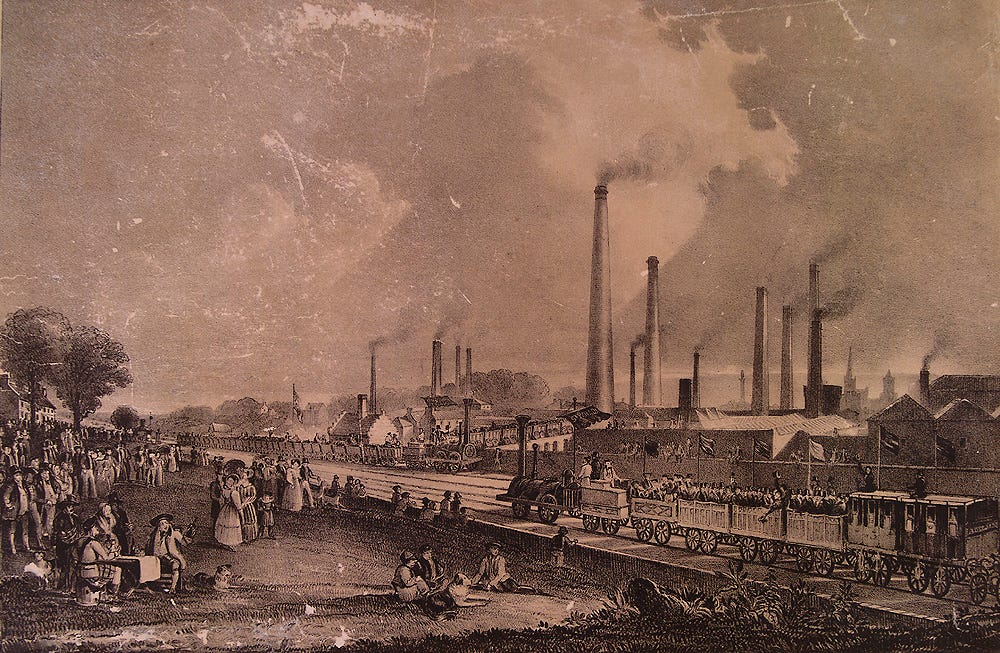
This is not the first time that technological progress has produced profound social inequality and political instability. During Britain’s Industrial Revolution, productivity surged decades before workers shared in the gains. The so-called Engels’ Pause – from the late-eighteenth to the mid-nineteenth century – combined extraordinary growth with stagnant wages, widening inequality, Dickensian urban poverty, and the emergence of radical class-based politics. Eventually, rising educational attainment, stronger worker bargaining power, and democratic reforms allowed wages to catch up with productivity. But the adjustment took generations, not business cycles.
Perhaps this too shall pass. Artificial intelligence may ultimately complement human capabilities more than replace them, just as previous technological revolutions eventually created industries and occupations that earlier generations could not imagine. More radically, intelligent machines may increasingly solve what Keynes, almost a century ago, described as humanity’s central “economic problem” – the economic necessity of work – leaving everyone freer to pursue lives of leisure, creativity, and human fulfilment. The difficulty may not be that Keynes was wrong, but that humanity’s transition to that future is proving more contested – and unequal – than he imagined.
The twentieth century was able to reconcile efficiency and equity because the industrial economy made that reconciliation possible. The twenty-first century is making it progressively more difficult – not because fairness matters less, but because growth itself is being generated in fundamentally different ways. We have yet to discover how to spread the benefits – and costs – created by an economy increasingly built on knowledge, algorithms, artificial intelligence, and other forms of intangible capital. Until we do, the same forces generating unprecedented economic progress will continue to test social cohesion, democratic legitimacy, and the stability of the very societies they are enriching.
If you enjoyed this, you may also like:



"But these choices have also coincided with slower productivity growth, fewer globally dominant technology companies, and persistent concern about economic competitiveness."
This is contrasted with the no regulation, no redistribution, US model.
Given that the US model has spawned a techno bro class that is set to consume fundamental resources like water, energy, forests, oceans at a rate that may be to the ultimate detriment of the planet and for the benefit of a handful - Europe's 'problems' barely register.
Thank-you for this thoughtful article. I agree with @heatherscoffield1 - there are big ideas here, and it will take some time to consider this piece. A first-blush reaction, though. You open with, "The great promise of the post-war era was that growth and fairness could advance together." You also need to consider that the post-war era began from a place of global destruction. A huge amount of productive capital had been wiped out, along with the wealth inequity that had reached crisis proportions before the wars. Post-war growth could not have occurred without some degree of "fairness" if we were to collectively rebuild. Perhaps the great challenge of the current world is to find policy solutions to avoid the need for another war to eliminate wealth disparity. Short of blowing up the server farms and data centres as collateral damage in a war scenario, how can we address wealth inequality so we can take a stab at a fairness agenda? Thank-you again for the thought-provoking article.